Showing posts with label green tea. Show all posts

Wednesday, December 2, 2015

The Tale of Two Dragon Wells

Dragon Well, or Long Jing is one of China's "Ten Famous Teas" and rightly so. A high-quality Long Jing is a delicious experience for any tea drinker. Trying to find quality, authentic Long Jing at a price that makes sense for the current market is a task, but still possible. I ordered two different Dragon Wells from two different vendors recently, both of similar grades. One was "superior" and the other was "special" - top quality other than they were not pre-qingming. The price-point difference per pound was only $12, but the subtleties in flavor and aroma stood out.

Dragon Well comes from Xihu (West Lake) area of Hangzhou in the Zhejiang Province of China. Hangzhou is the capital of Zhejian, and has a population of over 8 million people. The Xihu area is on the outskirts of Hangzhou, like Boulder is to Denver, or Sonoma to San Francisco. As you can see from the map below, a small set of mountains are located just to the west of Hangzhou, which is where Long Jing should come from.


This set of mountains has been designated and set aside as a scenic preserve and authentic Dragon Well should come from within this designated area. As you can see from the image below, this area is relatively small, and is just outside of the sprawling Hangzhou area.

As a result of Dragon Well being one of China's Ten Famous Teas, production cannot keep up with demand, just like many other well known teas. However, it is fairly easy to tell true Long Jing after tasting them for awhile.

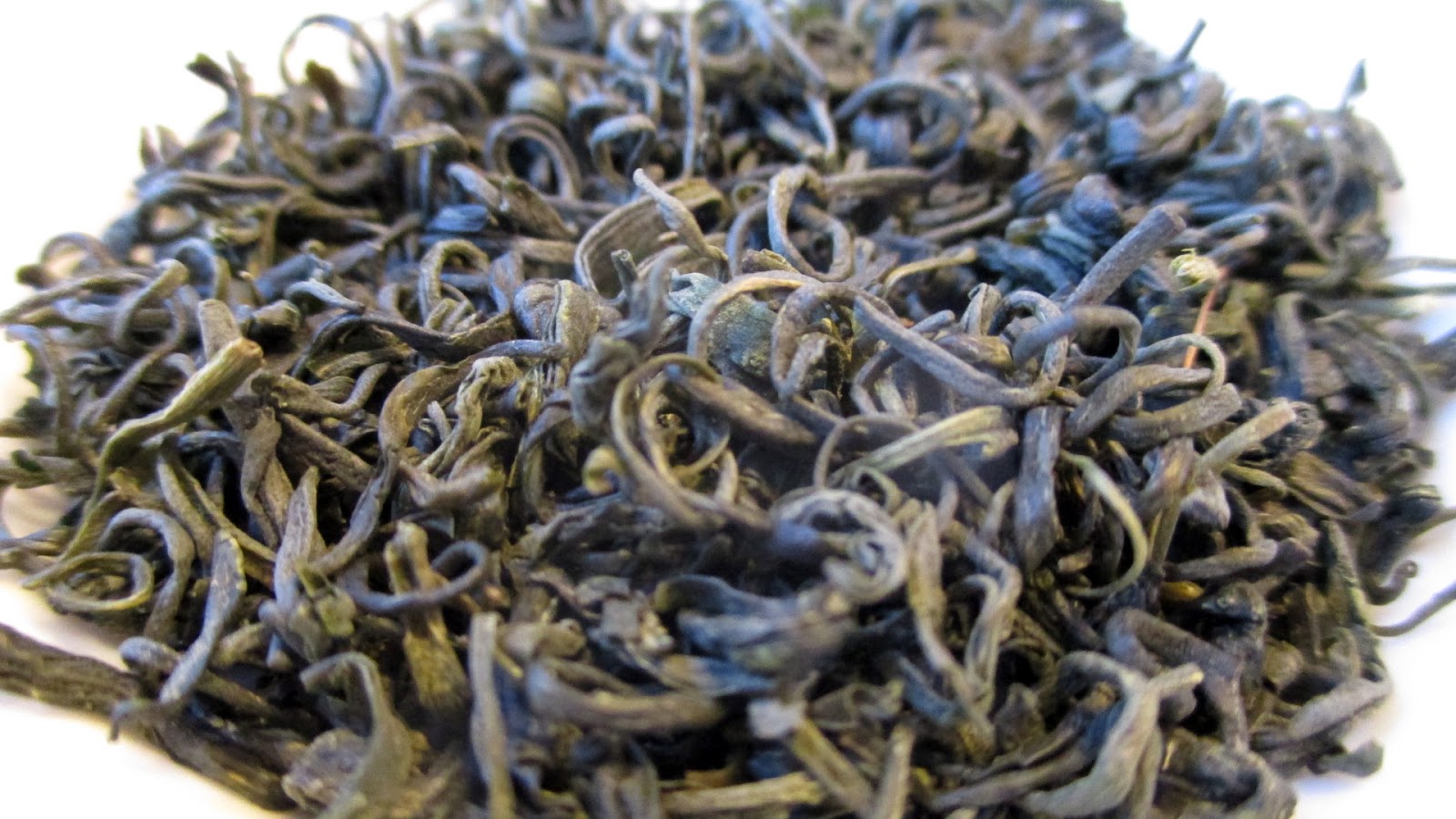
A close up of one of the samples.

The other sample.
 The two Dragon Wells that I was tasting on this day - a Special grade and a Superior grade - had obvious and marked differences. One smelled fresh, with the aroma of summer still prevalent when opening the bag. The other was more subdued, with less fresh aroma. One also had more uniform and standard green coloring of the dry leaves, which is one of the hallmarks of a top quality Long Jing. The other had less uniformity and more varied colors, edging toward blue/dark green leaves.

The two compared after one steeping.

A close up after two steepings.

The other one after two steepings.
 After tasting them both for two steepings each, I set aside the one that I felt was not as high of quality, and enjoyed three more steepings of my favorite one. The difference between the two was subtle, and whether a customer could tell the difference I don't know. For me, the subtle sweetness and nutty flavor of the one was obvious, while the other one's lack of fresh aroma and lasting flavor made it stand apart. The measurements also reinforced my tasting profiles:

Water
TDS - 74ppm
PH -7.42
Temp - 165

Brewed Tea (One I liked)
TDS - 241ppm
PH - 6.55
Temp - 155

Brewed Tea (One I set aside)
TDS - 235ppm
PH - 6.74
Temp - 155

My guess is that the one I set aside was picked slightly later and not treated to as high of standards, resulting in a slightly rougher tea, a bit more dry, and thus harder to extract from. The one I liked, on the other hand, was held to a higher standard during processing, resulting in fresher leaves that extracted a bit better. For me, paying the $12 more per pound to get the higher quality tea, despite being of the same "grade" is worth the price. It is also a lesson in knowing your vendors and what they specialize in.

Wednesday, November 18, 2015

Talking Taiwan Oolongs, Superior Puerh, and Green Needle Tea


Alishan Light Roast High Mountain Oolong

I feel a bit bad for posting this, as we got in around 300 grams of the Winter 2014 harvest to taste and review. I've had Alishan High Mountain from many sources, and the one we got this batch in from is one of the best (and the price reflects that). Aromatic, light, with plenty of tea oils to coat the back of the tongue and throat, allowing you to continue to enjoy the subtle flavors well after the last sip. This is what the modern, light roast, "jade" or "green" oolong is all about. I put out the 300 grams and it is pretty much all gone - if you are reading this today, there is enough left for a pot or two. However, don't fret, as I've put in a large order from the same farmer for several pounds of this winter's harvest. We do have some excellent Long Feng Xia High Mountain oolong, which is very similar but comes from the Shan Lin Xia area (Jhushan township of Nantou county) to the north. Alishan is the principal high mountain in the Mei shan area of Chiayi county, just south of Nantou in central Taiwan.


The tightly rolled leaves and stems open quickly in one to two steepings.


The big, bold leaves still attached to the stem.


This Alishan is from the Jin Xuan varietal, and the large, robust leaves reflect that. The readings I got on this tea for the third steeping of 30 seconds was***:

Water
TDS - 73ppm
PH - 7.72

Brewed Tea
TDS - 371ppm
PH - 6.34

Difference
TDS - 298
PH - 1.38

The Long Feng Xia, which I tasted on the 15th and will post later, for comparison, had a difference of 370 (TDS) and 1.03 (PH).

Superior Puerh - Shou Style 2010

Puerhs are an interesting thing - the cultural packaging around this tea has reached almost mythological proportions. "Symbols associated with Puer tea represent new national, regional, and individual identities to counterbalance prior identities and ongoing globalization" (Zhang, 2014, p. 23). These symbols and the cultural packaging around Puerh tea that has happened in the last 20 years are fascinating, and here in the West we have fully bought into them, as have many Chinese and others. "Many Yunnanese are confused by them, especially by the sudden appreciation for the flavor of aged Puer tea, which ironically was 'artificially' created by a group of advocates in only about five years..." (Zhang, 2014, p. 21). I'm just now delving in to this packaging and re-packaging of at one point what was thought to be a simple beverage, but that does not deny that I do enjoy good Puerh, and the Superior Puerh we have from 2010 is an excellent example of this recent mythology allowing one to enjoy a "drinkable antique."


An old leaf, but still partially intact.


 We have been sitting on this Puerh since 2010 when we acquired it. I have no idea as to the "factory" that it came from, as the package was unlabeled other than the name and date. It is certainly not from Menghai, but most likely one of the other larger factories. We have a number of "mystery" puerhs that we have acquired over the past 20+ years - does that make them any less exciting in terms of the tea itself and the journey it provides? I don't think so, and perhaps that makes them even more exciting, they are truly one-of-a-kind teas and their is only a small amount of them that we can offer. There is also a reason that these puerhs have no provenance - prior to the past 5-10 years, that was how puerh was packaged and sold. Even today, most puerh is blended in some fashion, even "wild arbor" stuff.

The readings I got doing the standard third steeping at 30 seconds:

Water
TDS - 103 (high day?)
PH - 7.68

Brewed Tea
TDS - 322
PH - 6.07

Difference
TDS - 229
PH - 1.61

Rainflower Needle Spring Green

This green was picked towards the end of the spring season in Jiangsu Province, China, and arrived on US shores in August during the start of the second green season. In the US, there are really four or five green seasons when buying: the first pre-qingming greens which we air freight directly in from China, the pre-qingming greens that come over on the boats and arrive later, the first summer greens again air freighted over, and then the summer greens that come via boats. Each has a different price point and freshness quality. This Rainflower (Yu Hua) green comes from Nan Jiang area, one of the ancient capitals of China and current capital of Jiangsu, located on the edge of the Yangtze River delta. Lower in elevation than other tea regions, this area has four distinct seasons, with spring being the best for producing fresh greens before the hot and muggy days of summer arrive.

Tightly hand rolled, then pan fired leaves in the form of needles.


A spring leaf, obvious when compared to the size of the ones above.

This Rainflower Needle batch is very good, exhibiting all the qualities that I enjoy in a spring green: freshness, vibrancy, vegetal flavors with sweet undertones. Steep it too long and it will become astringent, but flash steeps of 20-30 seconds produce lovely cups. It is always a gamble with boat greens, as you don't really know what kind of conditions the tea was subjected to on the long journey across the Pacific, but this batch seems to have survived well. Nice to have it around for a bit.

The readings I got were:

Water
TDS - 64
PH - 7.75

Brewed Tea
TDS - 396
PH - 6.25

Difference
TDS - 332
PH - 1.50

*** I'm collecting TDS, PH, and now temperature of every tea I drink and will post it here. There are several lines of investigation that is involved with this, but until I can at least come up with some baseline data, I will not conjecture about anything revolving around these numbers. However, tends are starting to make themselves apparent.

Thursday, October 8, 2015

Wulu Mountain Tribute Green, Tea Culture, and 2011 Man Tang Hong 2 Shou Puerh

I've been busy preparing for this Sunday's upcoming tea tasting on competition oolongs from Taiwan, but that doesn't stop me from trying teas on a daily basis. I'm also constantly researching tea and tea history, as I find what is out "there" really is inadequate or incorrect. I don't pretend to know very much, but I do find it frustrating when people do pretend to be authorities, yet it is obvious with a little research that what they are saying is not completely accurate. The real lesson is that if you are serious about tea, and want what you actually pay for, then you need to do a lot of research and learning. The internet is full of "authorities" or websites that are fudging their facts to make it sound like they have the "best" or "true" or "highest quality" tea out there.

This rule of caution may not hold as much truth when buying teas from Ceylon, Nilgiri, Assam, or Darjeeling, simply because you can generally get the quality and grade you pay for directly from the Estate. So, in the cafe, I buy directly from each Estate in these locations and have the tea air shipped in. This allows us to get the freshest tea possible from these locations. It may cost a bit more for the air shipping, but when you are dealing with a Moonshine Darjeeling, or a SFTGFOP Assam, or a Ceylon Silver Tip, fresh is the name of the game.

However, when talking about tea from China or Taiwan, if you do not know your source - and hopefully it is direct from farmer/grower/producer, then caution must be exercised. It is very easy to be sold a Long Feng Xia from Taiwan made of the Jin Xuan varietal when you wanted one from the Qing Xin varietal. Or a Wuyi Oolong that really is not Wuyi. And puerh is an entirely different story. So, education and research, every day is how I go about learning what is real and what is hype or exaggeration.

But part of this is also learning the larger history of tea and appreciating it in all forms across what many call "tea culture" - a culture that goes way back in history, for thousands of years.

This is a photo from the book "The Dali Lama's Secret Temple Tantric Wall Paintings from Tibet." This image is that of Chandrabhadra receiving an ambrosia. Accompanied with the photo below of the same wall painting, one may argue that the ambrosia is tea!

From the same book, this is Nagarjuna receiving some ambrosia from a forest spirit. But look at the tree - it sure looks like it could be a tea bush/tree. There is certainly a high reverence for tea among Tibetan Buddhists, and monks have been using tea for centuries to help with meditation practices.

Wulu Mountain Tribute Green

One of the newer green teas that I put out recently in the cafe. Another summer green, from the Anhui Province in China. The leaves were picked in June of this year, pan fired and slightly rolled by hand.  The liquor is delicious, classic green, with hints of herbaceous, grassy flavor that is found in well made summer greens.


The dried leaves, slightly curled.

I do fast steepings of around 20 seconds, for a slightly lighter cup.

The unfurled leaves.


Another images, this one from the book "Oriental Rugs and Carpets" by Stanley Reed. The image shows Mumtazi-i Mahal, wife of Shah Jahan in a 1726 painting.  Shah Jahan was the 5th Mughal Emperor of India. Here she is enjoying some tea, perhaps from the tree just behind her?

2011 Man Tang Hong "Number 2" Shou Puerh

This puerh was made from an average of grade 2 ripe tea leaves harvested from mature tea bushes in Mengku county (Lincang prefecture), in southwest Yunnan Province, China. The tea was made from spring leaves harvested and fermented during the summer of 2007, then allowed to age for 4 years before being blended and pressed. Finally, after six years of dry storage in Kunming the puerh was released onto the market. I only had a sample to try, and although I found it delicious, with a classic ripe puerh flavor and a smooth, dark liquor, I can't say much more. It was a perfect everyday drinking puerh.

The pressed, dried leaves.

Third steeping, deep and dark.


Wednesday, September 30, 2015

New Teas - Mist on the River Green, Bubbling Spring Rolled Green, Ceylon Silver Tips

As I've said earlier, I try and put out new teas every week or so. On top of the new one's described below, I put out a new Ceylon OPA from the same Estate as the Ceylon Silver Tips below and a new green - Wulu Mountain Tribute Green. I'll put photos of those up soon, but for now, these are the three new teas this week at the cafe.


New Teas – September 30th, 2015

It seems we are blessed with an “Indian Summer” this fall, and to celebrate these days of warm sunshine and cool nights, we are pleased to offer three summer teas to keep the energy of summer going before the cold, dark days of winter arrive. The three new teas are all summer harvests from this year, two from China and one from Sri Lanka.

Mist on the River Green This is a classic summer green tea coming from Jiangxi Province in China. Grown on the hills surrounding Lake Poyang, China’s largest freshwater lake, this tea is a result of the unique micro-climate produced by the lake. As moisture evaporates from the lake and then cools as it rises into the surrounding hills, the nearby tea bushes benefit. Gently harvested, the leaves with abundant silver strands are slightly twisted to allow for a slower opening during the steep process. The result is a supple, rich flavored tea that is easy on the palate, and a primary example of a delicious, organic, summer green tea. 
A nice close-up shot of the slightly twisted leaves.

I brewed this cup loose in a pint glass, then poured through a filter. It is another way to let the leaves fully open without using a gaiwan.

Small leaves, obviously a smaller leaf varietal.

Fully opened and fresh.

Bubbling Spring Rolled Green Despite the name, this is a summer green tea, coming from Zhejiang Province in China. Harvested in the early growth season of summer, the leaves are gently rolled and then pan-fired, resulting in small rolled pellets. However, once brewed, the pellets transform to reveal the tender yellow-green bud-sets of the early summer harvest. The fresh, sweet flavor is accompanied by hints of stone-fruit, with a pure, clean aftertaste. 
Tightly rolled balls, almost green-silvery in appearance.

Very fast steepings on this tea - 10-20 seconds at most.

A more uniform leave serration structure then on the Mist on the River Green above.

Opened, but still ready for more steepings as evidenced by the still folded leaves.

Ceylon Silver Tips A rare white tea from Sri Lanka consisting purely of slender, slightly curved silver buds. Harvested from the Maliboda gardens in the Kegalle district, this rare white tea has the gentlest hints of citrus-spice with subtle sweetness, along with floral notes at the finish. A perfect afternoon tea for these warm, fall days. 
A delicious Silver Tips, but not as many micro-hairs as on the Chinese one's we usually get.

A very light brew, but ever so sweet and fruity.


Since these are just buds, you can tell that by the leaf size, these are from the Assamica varietal.

Thursday, September 24, 2015

Zomba Pearls - A Unique "White" Tea from Malawi


"Situated about halfway between Mulanje and Blantyre, Thyolo - pronounced Cholo - is the tea capital of Malawi, and one of the oldest towns in the country. ... The main tourist focus in the Thyolo area is Satemwa Tea Estate, which was one of the first European land claims registered in Malawi, dating back to 1874, and has been in the same family since 1923, when it was acquired by Maclean Kay, a rubber planter from Malaya" (Briggs, 2013, p. 225).

The other day I had the chance to taste one of the more unique "white" teas I've ever had - the Zomba Pearls from the Satemwa Tea Estate. These intricately and tightly wound pearls were from the 2015 spring harvest, and I was highly intrigued to try them out. I have been searching for a couple good teas from Africa to fill out our tea selection at the cafe, but since most of my sources focus on China, Taiwan, and India I don't have a good starting point. I normally associate African teas with Kenya and Tanzania - except for Rooibos, which comes from South Africa - and was surprised to learn that Malawi has teas. Just goes to show how little I know!

It turns out, as I was researching Malawi and the Satemwa Tea Estate, that Malawi has the oldest tea culture in all of Africa. As part of the East India Company's search for new tea sources after losing the monopoly over the China tea trade at the turn of the 19th century, tea was planted in almost all of Britain's colonies. Seeds from the Royal Botanical Gardens in South Africa were planted in South Africa and Malawi, but they did not survive. Next, seeds from the Royal Botanical Gardens in Edinburgh were brought over and planted in 1878 - those survived and started the tea industry in Malawi. Now, that was at the height of the colonial period, and many of the tea estates in Malawi have changed hands since then, so it is hard to figure out exactly what tea varietal is currently planted on what estate. I have a query out concerning the tea plants on the Satemwa Tea Estate, and when I hear back I will update this post, but my assumption is that it is a clonal Assamica variety, based on the flavor of the tea and the size of the leaves.

[Update 9/26/2015 - I heard back from Tealet, who is now bringing in Satemwa teas to the U.S. Here is what they said: "The Malawi teas are from a mix of varietals developed over the years, majority Assamica and minority Sinensis. The Assamica teas were first brought in by Scottish growers - I'm not sure if Satemwa's material is sourced particularly from the Edinburgh Gardens, but some of Malawi's teas do trace back to there. Later cultivars were developed by the Tea Research Foundation of Central Africa: http://www.trfca.net/central.html. This is similar to Taiwan's Tea Research Extension Station, where the researchers help bring in new plant material and also help develop cultivars that are well-suited to the environment."]

"By 1995, 16% of the crop [in Malawi] was clonal tea. Estimates for 2004 predict 26% of the harvest will be under new clones" (Hall. 2000. Chapter 5, p. 25). Assamica varietals are not known for their white teas, even though every year I see more and more of them coming to market from India. Located on the slopes of Thyolo Mountain at an elevation of roughly 4,000' the Satemwa Tea Estate has produced a unique "white" tea called Zomba Pearls that seems to fit in with this trend.

Now, I don't know if giving a review is the right thing to do - tea is so unique, and a positive or negative review largely depends on the drinkers personal preferences, the water they use to brew the tea, the temperature of that water, steep times, and more. The way I brew tea may result in one flavor profile, while the way you brew tea may result in another. As such, I think reviews don't quite work with tea. That doesn't mean a nice presentation of a unique tea is not worthy of a post - on the contrary, it demands it.

The Zomba Pearls close up - very tightly woven together.


This is from the second steeping - they are not even close to opening up.

The leaves produced a nice liquor with an interesting flavor profile of green beans, cucumber, and the ever so slight flavorings of dried fruit.

One of the leaves fully opened - good size, looks like an Assamic clonal varietal to me.
Each one of the little "pearls" is made individually by hand. In order for the pearls to be formed, the freshly plucked leaves are not gathered in a basket as is typical on most tea estates, but rather each leaf is carefully layered on top of the other in the field so that the leaves are not damaged and can be stored fresh and cool. After 24 hours of withering, the leaves are rolled by hand and then immediately dried. That is the only processing that takes place, and it is for this reason that the tea is called a "white" tea. However, as one can see from the size of the leaves above, it is not a tea produced from the initial first buds that make up white teas in China. Rather, it looks to me to be a fairly mature leaf, so I would classify the tea as a green and not a white. But that begs the question - do you classify tea based on harvest time or the amount of processing that takes place with the leaves, or both?

The Zomba Pearls are certainly a unique tea, and if you are looking for something that can handle many, many steepings, this might be it. The pearls were not even fully open after 6 steepings in a gaiwan, and the liquor and flavor was still there just as in the first steeping. As a tea buyer I have to think about my customers and how this tea would do in the cafe. I might buy a pound or two depending on the price, but I think only tea connoisseurs or those who are adventurous in their tea drinking will select this tea - your everyday drinker might not know how to categorize it since they generally prefer a standard green or a strong black.

Sources Cite:

Briggs, Philip. 2013. Malawi. Bradt Travel Guides, Sixth Edition.

Hall, Nick. 2000. The Tea Industry. Cambridge, UK: Woodhead Publishing.